

What Is a Facial Tissue Packing Machine?
A Facial Tissue Packing Machine is packaging equipment used to pack folded facial tissue into soft packs, box packs, or other retail-ready formats. It is usually installed after the tissue folding and cutting process, helping manufacturers improve packaging speed, reduce manual labor, and keep product appearance consistent.
For tissue manufacturers, packaging is not only about wrapping the product. It affects shelf presentation, sealing quality, hygiene control, production efficiency, and brand image. A well-matched facial tissue packing machine can help the production line run more smoothly, especially when the factory handles large-volume orders or multiple packaging specifications.
Depending on the production requirement, the machine may include automatic tissue feeding, film wrapping, side sealing, end sealing, labeling support, counting functions, and connection with upstream or downstream equipment. Some factories use semi-automatic equipment for flexible small-batch production, while larger manufacturers usually prefer fully automatic packing systems for stable output.
When comparing facial tissue packing machines, buyers should not only focus on speed. A good machine should match tissue size, packing style, film material, production capacity, available factory space, operator skill level, and after-sales support. These factors directly affect long-term operation costs and production stability.
Where Is a Facial Tissue Packing Machine Used?
A facial tissue packing machine is mainly used in paper converting plants and hygiene product factories. It is suitable for businesses that produce facial tissue, soft pack tissue, boxed tissue, travel tissue, and customized private-label tissue products.
Facial Tissue Manufacturing Plants
Tissue manufacturers often need stable packaging equipment to support daily production. When output increases, manual packing can become slow and inconsistent. A facial tissue packing machine helps standardize the packing process and improve product consistency.
Private-Label Tissue Production
Many brands outsource facial tissue production to OEM or ODM factories. These factories often handle different package sizes, film designs, and customer specifications. A flexible facial tissue packing machine can support faster changeover and more stable customized production.
Retail and Wholesale Packaging Lines
For products sold through supermarkets, convenience stores, distributors, or e-commerce channels, packaging appearance matters. Clean sealing, accurate counting, and stable pack shape can improve customer trust and reduce product rejection during quality inspection.
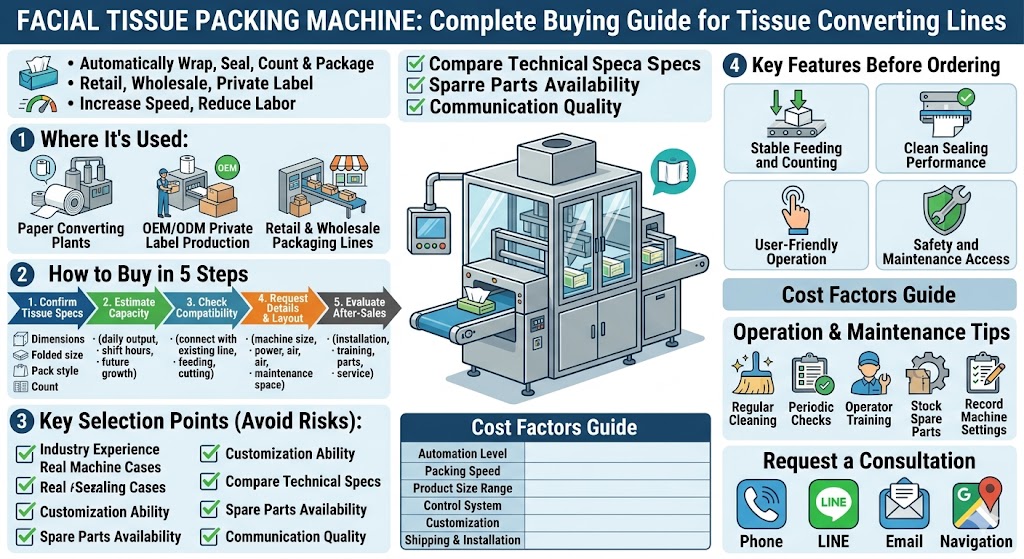
How to Buy a Facial Tissue Packing Machine in 5 Steps
Buying a facial tissue packing machine is not a simple price comparison. The right machine should match your tissue production line, target capacity, packaging format, and long-term maintenance plan. The following five steps can help buyers evaluate the purchase more clearly.
Step 1: Confirm Tissue Size and Packing Format
Before requesting a quotation, prepare your tissue specifications. This includes sheet size, folded size, tissue count per pack, pack dimensions, film type, and whether the final product is a soft pack or box pack. Clear specifications help the supplier recommend a suitable machine model.
Step 2: Estimate Production Capacity
Machine speed should match your real production demand. A high-speed machine may not be necessary for small-volume production, while a low-capacity machine may limit factory growth. Buyers should calculate daily output targets, shift hours, and expected future expansion.
Step 3: Check Machine Compatibility
The facial tissue packing machine should connect smoothly with upstream folding, cutting, and transferring equipment. If the machine cannot integrate well with the existing line, production may experience jams, unstable feeding, or additional labor requirements.
Step 4: Request Technical Details and Layout
Ask the supplier for machine dimensions, power requirements, air consumption, recommended factory layout, operating direction, and maintenance access space. This prevents installation problems after the machine arrives.
Step 5: Evaluate Training and After-Sales Support
Reliable technical support is important for long-term use. Buyers should confirm whether the supplier provides installation guidance, operator training, spare parts, troubleshooting support, and remote service. These details can reduce downtime after production starts.
How to Choose the Right Facial Tissue Packing Machine Supplier
A facial tissue packing machine is a long-term production investment. Choosing the right supplier is just as important as choosing the machine model. Below are six practical points to help buyers avoid common purchasing risks.
- Check industry experience: Choose a supplier with real experience in tissue converting and packaging equipment, not only general packaging machinery.
- Review machine cases: Ask for similar project references, machine videos, or sample packaging results for facial tissue products.
- Confirm customization ability: Different markets may require different pack sizes, film types, and labeling needs, so customization support is important.
- Compare technical specifications: Do not compare only the machine price. Compare speed, stability, sealing method, control system, and changeover convenience.
- Ask about spare parts: Long waiting times for spare parts can affect production. Make sure key components are available and clearly listed.
- Evaluate communication quality: A supplier that responds clearly before purchase is more likely to provide better support after installation.
A good supplier should be able to explain which model fits your product, what limitations may exist, and how the machine should be maintained. Be careful with quotations that only emphasize low price but provide limited technical information.
Facial Tissue Packing Machine Cost Factors
The cost of a facial tissue packing machine can vary widely because every production line has different needs. Instead of giving a random price, it is more useful to understand what affects the final quotation.
| Cost Factor | Why It Matters |
|---|---|
| Automation Level | Fully automatic machines usually cost more than semi-automatic models but can reduce labor and improve consistency. |
| Packing Speed | Higher-speed machines require stronger mechanical design, better control systems, and more stable feeding structures. |
| Product Size Range | Machines that support multiple pack sizes or fast changeover may require additional adjustment mechanisms. |
| Control System | PLC, touchscreen interface, sensors, and servo systems can improve operation control and fault detection. |
| Customization | Special film types, pack shapes, conveyors, labeling systems, or integration requirements can affect the total cost. |
| Shipping and Installation | Export packing, freight, import duties, installation support, and training should be included in the budget plan. |
Buyers should request a detailed quotation that includes machine scope, included accessories, spare parts, warranty terms, installation support, and delivery schedule. This makes comparison more accurate and prevents hidden costs during implementation.
Key Features to Check Before Ordering
The best facial tissue packing machine is not always the most expensive one. It is the machine that matches your product, labor structure, production target, and market positioning. Before ordering, buyers should review several key features carefully.
Stable Feeding and Counting
Facial tissue products are soft and lightweight, so feeding stability is important. Poor feeding design may cause misalignment, wrinkles, or inconsistent pack shape. Accurate counting also helps maintain product consistency and customer trust.
Clean Sealing Performance
Sealing quality affects product appearance and shelf readiness. The machine should produce stable seals without excessive heat damage, loose edges, or film deformation. For branded tissue products, clean packaging is especially important.
User-Friendly Operation
A clear control panel, reasonable machine layout, and easy adjustment structure can reduce operator training time. If the factory handles different product sizes, fast and repeatable adjustment becomes even more valuable.
Safety and Maintenance Access
Safety guards, emergency stop buttons, accessible maintenance points, and clear fault alarms help protect operators and reduce downtime. A machine that is difficult to inspect or clean may create long-term operational problems.
Maintenance and Operation Tips
Good maintenance helps extend machine life and keep the packing line stable. Even a high-quality facial tissue packing machine needs regular inspection and proper operation.
- Clean film feeding areas, sealing parts, and sensors regularly to prevent dust buildup.
- Check cutting blades, sealing bars, belts, and moving parts according to the maintenance schedule.
- Train operators to identify abnormal noise, unstable feeding, poor sealing, and alarm messages.
- Keep essential spare parts in stock to reduce downtime during urgent production periods.
- Record machine settings for each product size to make future changeovers faster and more accurate.
Regular maintenance is not only about preventing machine failure. It also helps maintain packaging quality, reduce film waste, and improve overall production efficiency.
Request a Facial Tissue Packing Machine Consultation
When planning to purchase a facial tissue packing machine, prepare your product size, target capacity, packing style, film material, and factory layout in advance. These details help the supplier recommend a suitable model and provide a more accurate quotation.
For manufacturers upgrading from manual packing or expanding facial tissue production, the right packing machine can improve efficiency, reduce labor pressure, and support more consistent product quality. Contact the supplier by phone, LINE, email, inquiry form, or navigation to the factory showroom to discuss your production requirements and machine configuration.
Facial Tissue Packing Machine FAQ
Q1: What is a facial tissue packing machine used for?
A facial tissue packing machine is used to automatically package facial tissue products into soft packs, retail packs, or other finished packaging formats after the tissue folding and cutting process.
Q2: What production lines can use a facial tissue packing machine?
It is commonly used in facial tissue converting lines, hygiene paper factories, private-label tissue production lines, and retail tissue packaging operations.
Q3: How do I choose the right facial tissue packing machine?
You should compare tissue size compatibility, packing speed, sealing quality, automation level, machine layout, supplier experience, and after-sales support before choosing a model.
Q4: How much does a facial tissue packing machine cost?
The cost depends on automation level, speed, product size range, control system, customization requirements, shipping, installation, and service scope. A detailed quotation is recommended.
Q5: Can the machine handle different facial tissue pack sizes?
Many machines can support different pack sizes within a specified range, but the adjustment method and changeover time depend on the machine design.
Q6: Can a facial tissue packing machine connect with an existing folding machine?
In many cases, it can be integrated with an existing folding and cutting line, but compatibility should be checked based on feeding direction, output speed, product size, and factory layout.
Q7: How long does installation usually take?
Installation time depends on machine complexity, factory preparation, operator training, and line integration. Buyers should confirm the installation schedule with the supplier before shipment.
Q8: What information should I provide before requesting a quotation?
Prepare tissue size, pack size, tissue count per pack, film material, target speed, preferred automation level, factory layout, and any special packaging requirements.
Q9: Does the machine require regular maintenance?
Yes. Regular cleaning, inspection of sealing parts, blade checks, sensor cleaning, and spare part replacement help maintain stable production and packaging quality.
Q10: How can I contact a supplier for a facial tissue packing machine?
You can contact the supplier by phone, LINE, email, website inquiry form, or navigation to the factory showroom. Providing clear product specifications will help the supplier respond more accurately.